Agriculture and land management are entering a new stage of mechanization.
For decades, the development of agricultural machinery was primarily focused on increasing horsepower, working width, and mechanical productivity. Today, the priorities are becoming broader. Farmers, contractors, and property managers are also looking for equipment that can reduce labor dependency, improve operator safety, and work effectively in difficult environments.
This change is particularly visible in vegetation management.
In 2026, labor availability has become an increasingly important consideration for agricultural businesses. A recent study from the Brazilian Confederation of Agriculture and Livestock found that 44.5% of surveyed producers identified labor as their main challenge. The study also reported that 42.6% had accelerated investments in mechanization and automation in response to labor shortages.
For machinery manufacturers, this represents more than a short-term market trend. It points toward a structural change in how agricultural and land maintenance work will be performed.
Grass cutting sounds like a simple operation until it takes place across hundreds of hectares, steep slopes, orchards, roadside areas, or uneven agricultural land.
In these environments, conventional mowing equipment can create several challenges.
The operator needs to remain close to the machine. Difficult terrain can reduce mobility. Slopes can increase operational risks. At the same time, businesses need to complete regular vegetation management without continuously increasing labor costs.
This is where remote-control mowing technology becomes particularly interesting.
Instead of putting the operator directly on the machine, a remote-control mower separates the person from the working environment. The operator can observe the machine while controlling its movement and mowing operation from a safer position.
The concept is simple, but its implications are significant.
When people hear the term "remote-control mower," they may initially think of a consumer robotic lawn mower.
Professional remote-control mowing equipment is fundamentally different.
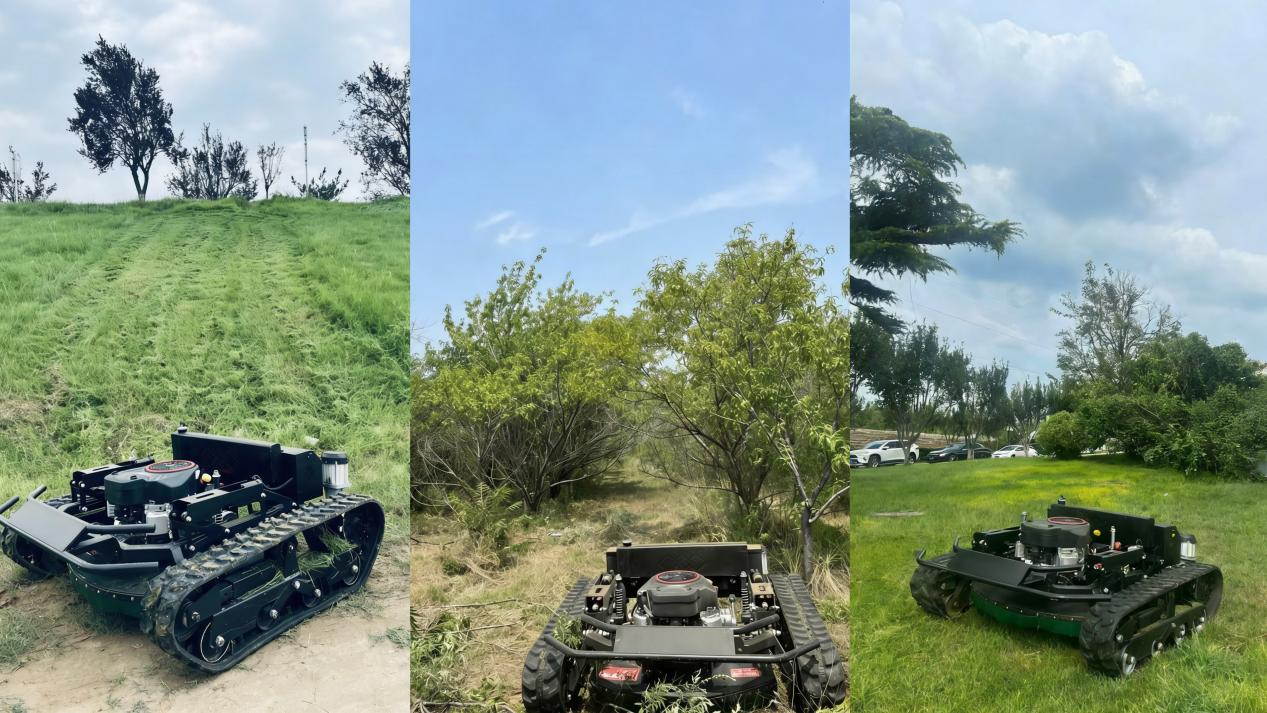
Machines such as Kesen's KS900 are designed for demanding outdoor environments where terrain adaptability, traction, cutting performance, and machine durability are essential.
The KS900 uses a crawler-track platform and is designed for professional vegetation management. Its application range can include farms, orchards, slopes, roadside areas, landscaping projects, and other locations where conventional mowing equipment may face limitations.
The key advantage is not simply that the machine can be controlled remotely.
It is the combination of remote operation and heavy-duty mobility.
Agricultural land is rarely perfectly flat.
A machine used for professional vegetation management may encounter loose soil, uneven surfaces, slopes, grass-covered ground, and changing terrain conditions during the same working day.
For this reason, mobility is just as important as cutting performance.
A crawler-based platform can provide continuous ground contact and stable traction, helping the machine move across challenging terrain.
For operators working on slopes or difficult ground, this can change the entire mowing process. Instead of asking whether a conventional machine can safely access a particular area, the question becomes how a remote-control machine can be deployed most efficiently.
Remote-control technology does not necessarily eliminate the operator.
Instead, it changes the operator's role.
Rather than sitting on a mower and physically following every movement of the machine, the operator becomes responsible for controlling, monitoring, and managing the mowing operation.
This can reduce physical fatigue and allow the operator to maintain a better view of the working environment.
For professional contractors, this distinction is important. The objective is not simply to replace people with machines, but to make each operator more productive.
That is one reason automation and mechanization are becoming increasingly relevant in modern agriculture.
The potential applications extend well beyond traditional lawns.
Remote-control mowing equipment can be considered for:
Each application has different requirements, but the underlying need is similar: vegetation needs to be controlled efficiently in places where conventional mowing can be difficult, labor-intensive, or less suitable.
The growing interest in intelligent agricultural machinery was also visible at Agrishow 2026 in Brazil. The exhibition highlighted the increasing role of automation, digital tools, data-driven management, and technologies designed to improve operational efficiency.
For Kesen Machinery, this direction is closely connected with our own product development.
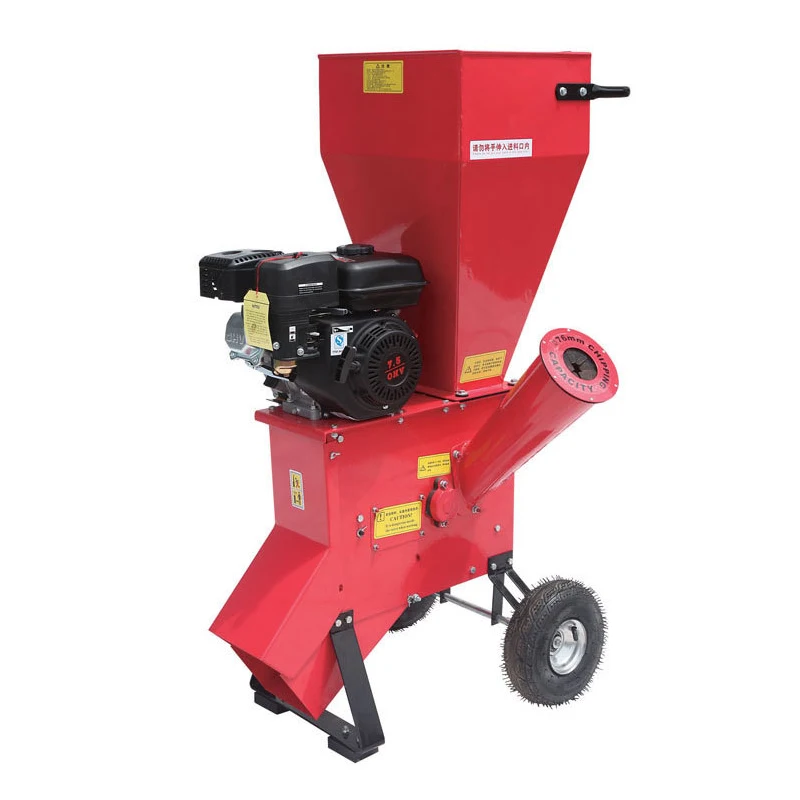
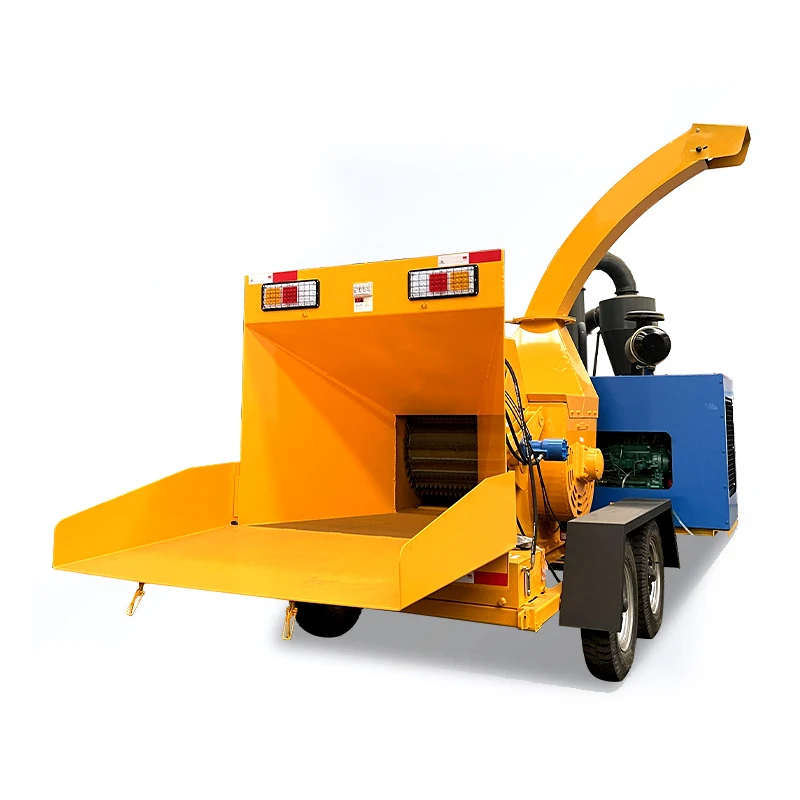
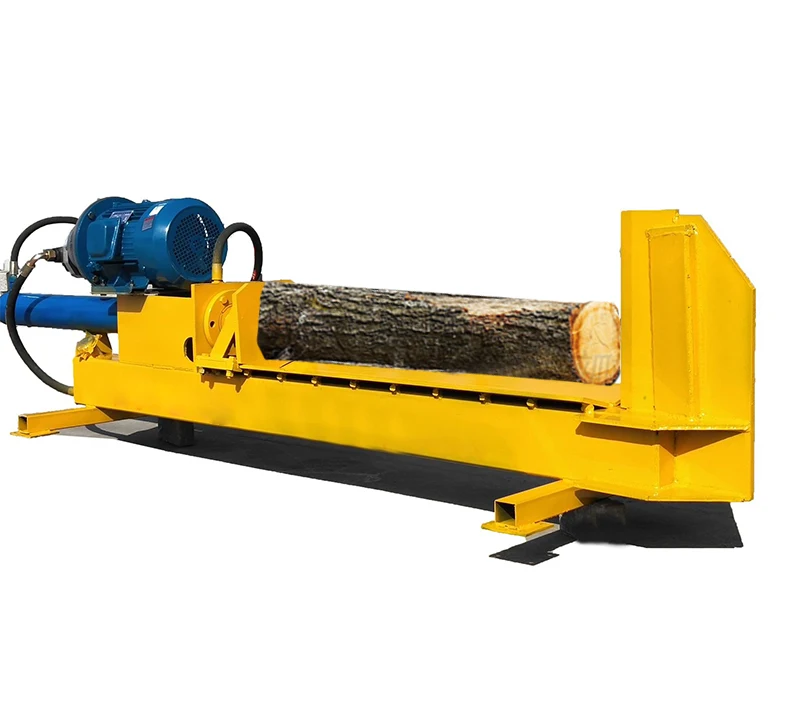
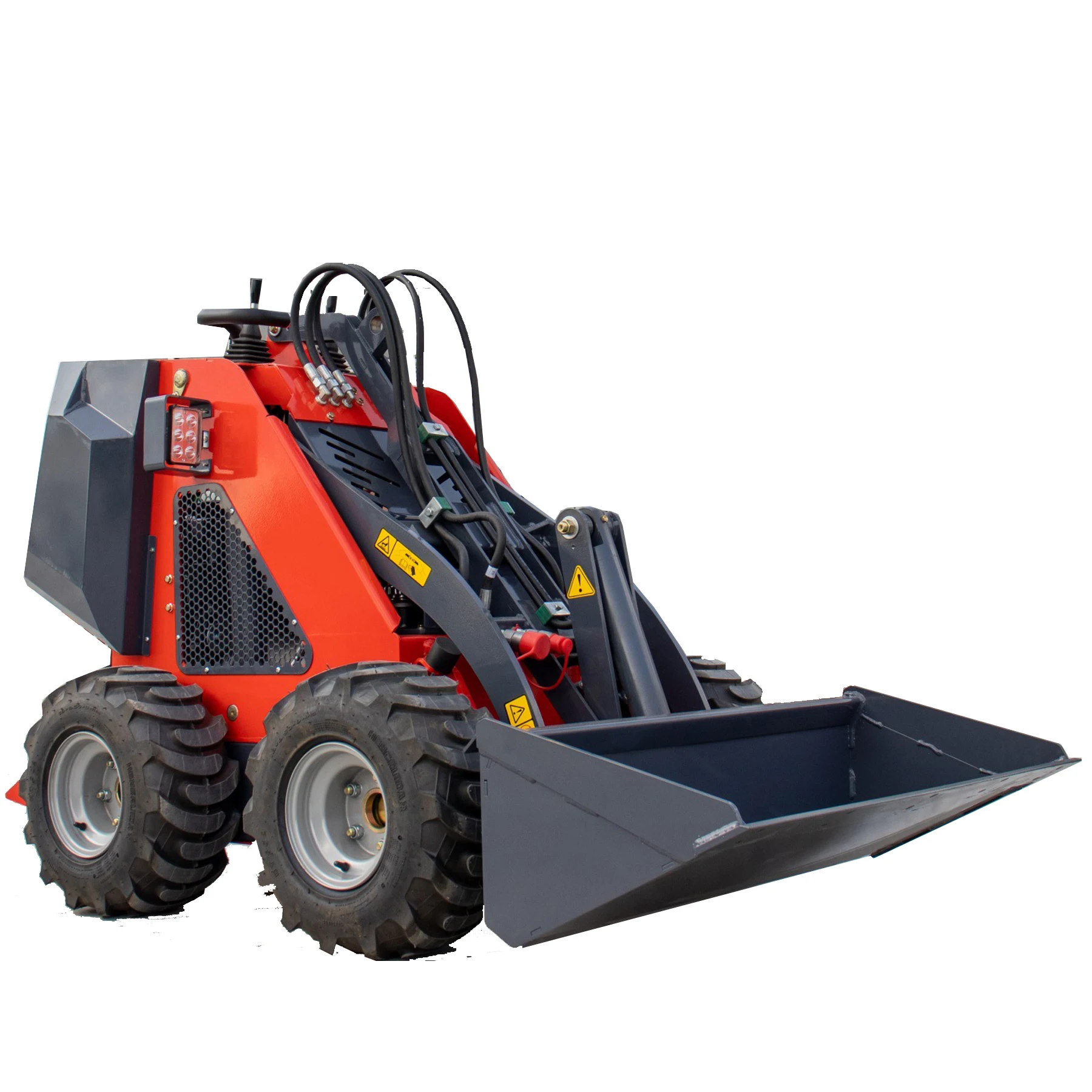
Kesen has focused on forestry and garden machinery for more than 20 years, with a product portfolio covering remote-control lawn mowers, wood chippers, band sawmills, log splitters, and related equipment.
The development of remote-control mowing technology is therefore part of a broader strategy: providing machinery that addresses practical problems in forestry, agriculture, landscaping, and property maintenance.
The future of agricultural machinery will not be defined by automation alone.
The most useful machines will be those that combine automation with durability, practical operation, terrain adaptability, and reasonable operating costs.
Remote-control mowers are one example of this evolution.
As labor availability becomes a more important factor and land management requirements continue to grow, professional users will increasingly evaluate machinery based on the complete working solution rather than horsepower or purchase price alone.
At Kesen Machinery, we believe the next generation of forestry and garden equipment should make difficult work safer, more efficient, and easier to manage.
The KS900 is one step in that direction.
And as agriculture continues to change, so will the machinery that supports it.
 Hot News
2026-06-16
2024-12-26
2024-12-26
2024-10-11
2024-09-18
2024-09-09
Kesen Machinery was founded in 2003 with the goal of producing high-quality products for customers and providing world-class equipment support for all forestry and construction customers.
Copyright © Shandong Kesen Machinery Manufacturing Co., Ltd. All Rights Reserved- Privacy Policy- Blog
 EN
EN