Managing thick vegetation on extreme inclines has traditionally been one of the costliest and most hazardous assignments in commercial landscaping. Grounds maintenance contractors, municipal highway authorities, and utility operators routinely confront slopes exceeding 35 to 45 degrees, retention pond basins, and densely spaced solar panel arrays. For decades, maintenance teams relied either on manual brush clearing crews equipped with string trimmers or conventional ride-on tractors.
Both legacy methods present unacceptable trade-offs. Manual weed-whacking on slippery embankments results in severe slip-and-fall injuries and exorbitant labor expenses, while ride-on machinery carries a perpetual risk of lethal rollover accidents. The advent of industrial-grade remote control slope mowers has revolutionized commercial vegetation management, replacing high-risk manual labor with high-torque precision robotics controlled from up to 200 meters away.
1. High-Stakes Application Scenarios for RC Slope Mowers
Modern tracked robotic mowers are engineered for severe operational conditions where conventional power equipment cannot safely tread:
2. Five Critical Selection Criteria for Commercial Buyers
Selecting the right commercial slope grass cutter requires evaluating machine architecture against punishing ground conditions:
1. Track Underpinning & Center of Gravity (CoG)
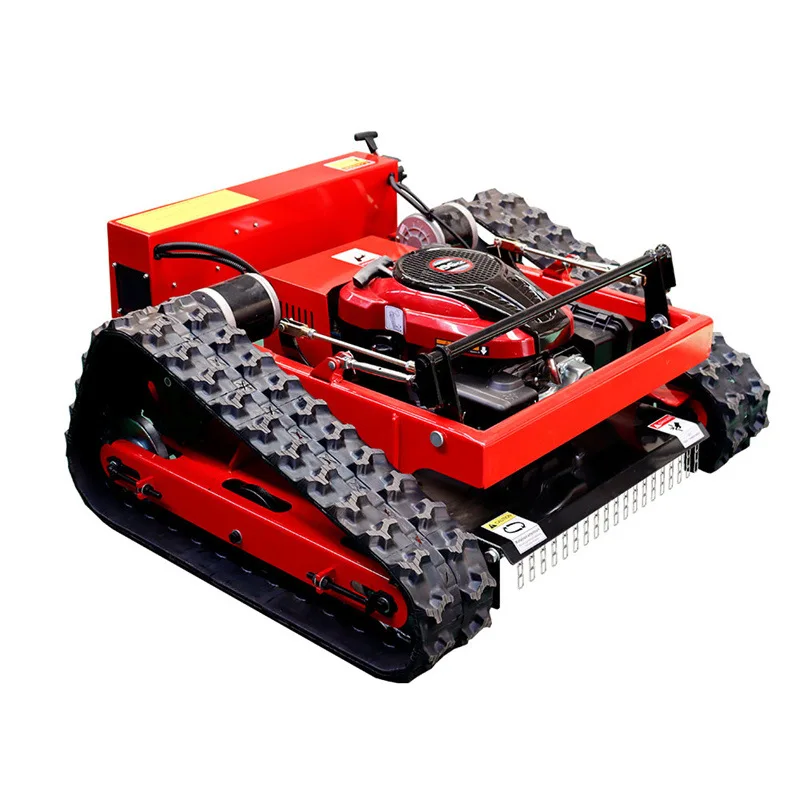
A true commercial slope mower must incorporate an ultra-low center of gravity, with engines and hydraulic assemblies mounted directly on the lower chassis frame. Look for high-grip engineered rubber tracks with aggressive multi-lug patterns. A wide track stance distributes machine weight evenly, enabling safe gradeability up to 45°–50° without side-slipping.
2. Hybrid Powertrain Architecture
Pure battery mowers lack the continuous power to cut dense saplings over extended shifts, whereas pure internal combustion mowers struggle with erratic hydraulic pump stalling on extreme angles. The ideal commercial setup is a hybrid configuration: an EPA/CE-certified industrial gasoline or diesel engine powering high-torque electric drive motors, ensuring uninterrupted blade rpm while dynamic electric steering maintains constant uphill torque.
3. Floating Cutter Deck with Mulching Technology
Fixed decks gouge scalping ridges on undulating hillsides. Look for a bidirectional floating cutter deck with height adjustment ranging from 20 mm to 150 mm. High-strength manganese or boron steel swing blades deflect automatically when striking embedded rocks, pulverizing brush into fine mulch that returns nutrients directly to the soil.
4. Telemetry Range & Safety Failsafes
Industrial operations demand industrial 2.4 GHz digital radio telemetry offering at least 200 meters of reliable non-line-of-sight range. Critical safety standards include automatic emergency engine shutoff upon signal interruption, active mechanical parking brakes on steep grades, and physical roll-cage protection.
5. Compliance and Component Longevity
Commercial purchasers must verify environmental and mechanical safety credentials, such as CE machinery directive compliance and EPA emissions approval. Ensure the manufacturer offers structured spare-part availability (such as 5-year coverage on wearable hydraulic and track components) to eliminate mid-season downtime.
3. Best Practices: Daily Operation and Preventive Maintenance SOP
To safeguard your capital investment and maintain field reliability, operators should follow a disciplined preventive maintenance checklist:
4. Frequently Asked Questions (FAQs)
Q: Can remote control mowers operate on wet, muddy inclines?
A: While wide rubber tracks provide exceptional traction, saturated clay or wet grass on inclines above 35° reduces friction coefficients. For optimal safety, cross slopes diagonally at lower speeds and inspect track tread depth before wet-season operations.
Q: What happens if the radio signal drops out during steep slope cutting?
A: Industrial RC mowers feature fail-safe control logic. If interference breaks communication or the remote battery dies, the engine immediately disengages the cutter blade and engages internal spring-loaded parking brakes, locking the machine in place within 0.2 seconds.
Q: How does the operating cost compare to traditional contract mowing crews?
A: Field data demonstrates that one operator utilizing a commercial tracked slope mower achieves the hourly production rate of 5 to 7 workers with string trimmers, while reducing worker compensation liability claims to near zero. Most commercial contractors recover equipment acquisition costs within 4 to 6 months of active deployment.
 Hot News
2026-06-16
2024-12-26
2024-12-26
2024-10-11
2024-09-18
2024-09-09
Kesen Machinery was founded in 2003 with the goal of producing high-quality products for customers and providing world-class equipment support for all forestry and construction customers.
Copyright © Shandong Kesen Machinery Manufacturing Co., Ltd. All Rights Reserved- Privacy Policy- Blog
 EN